
The PSEB Registration Mistake That’s Costing Pakistani Software Houses Their Export Tax Benefits
A software house in Lahore lands its first international client, starts receiving export payments, and assumes the paperwork is sorted. Eight months later, while preparing tax filings, the founders realised they never completed PSEB registration. Software house registration in Pakistan isn’t just about SECP incorporation, and this one gap can quietly affect eligibility for export-related tax benefits. Could it have been avoided with the right sequence from day one? Almost always, yes.
Why Does This One Mistake Become an Expensive Problem?
Founders spend their energy building products and closing clients. Compliance sits at the bottom of the list, until a tax filing or an investor due-diligence request forces it to the top. By then, the cost isn’t just a missed incentive, it’s delayed growth, extra audit scrutiny, and awkward conversations with clients who expect a properly registered vendor. Registration is the starting line, not the finish line, ongoing compliance is what actually protects the business.
Understanding Pakistan’s Software Export Compliance Ecosystem
No single authority covers everything, which is exactly why founders get confused.
| Authority | Primary Role | Why It Matters |
| SECP | Company incorporation | Establishes your legal entity |
| FBR | Tax registration and filings | Governs your NTN and tax obligations |
| PSEB | Industry registration for IT/software exporters | Often tied to export-related tax treatment |
| SBP | Foreign exchange regulation | Governs how export proceeds are received |
| Commercial banks | Payment receipt and documentation | Where export proceeds actually land |
Each one plays a distinct role. Registering with SECP alone doesn’t automatically satisfy the others.
The PSEB Registration Mistake, Explained
The mistake usually isn’t outright forgetting PSEB, it’s assuming SECP registration was enough, or registering only after export activity has already started. Some founders miss renewal deadlines entirely, unaware that registration isn’t a one-time task. Others assume their accountant has it handled, when in reality nobody was explicitly tasked with it. Conflicting advice from different consultants doesn’t help either.
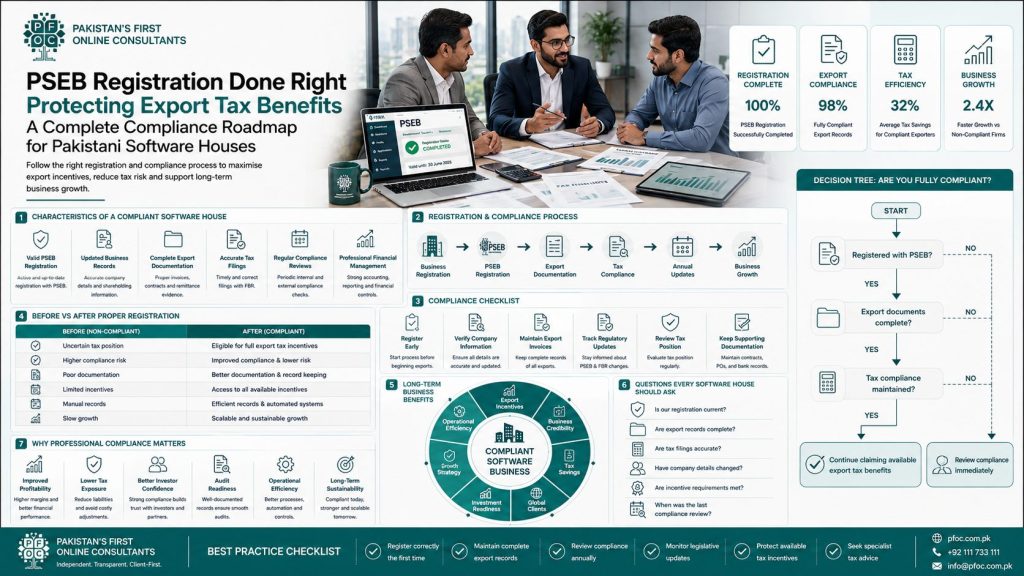
When Should a Software House Register? A Practical Timeline
- Decide on your business idea and structure
- Register with SECP
- Obtain your NTN and complete FBR tax registration
- Open a business bank account
- Complete PSEB registration
- Sign international contracts
- Issue your first export invoice
- Receive foreign payments
- Maintain records and file returns
- Track renewals annually
Following this order, rather than exporting first and registering later, keeps every downstream step aligned.
What Happens If Registration Is Delayed?
Consequences vary depending on individual circumstances and current regulations, so this isn’t a blanket rule, but delayed or incomplete registration can mean slower access to eligible tax treatment, extra documentation work to correct records retroactively, banking complications when proving the source of export income, and closer scrutiny during audits. None of this is catastrophic on its own. It’s just avoidable friction that compounds over time.
Common Compliance Mistakes Beyond PSEB
Using a personal bank account for export income blurs the line between business and personal finances, and it complicates FBR filings later. Poor documentation, missing contracts, incomplete invoices, is the second-biggest issue; when a client or bank asks for proof, “I’m sure we have it somewhere” isn’t a good answer. Mixing freelance income with company revenue, missing renewal deadlines, and assuming one registration covers every future obligation round out the list. Annual compliance reviews catch most of these before they become expensive.
Founders who treat software house registration in Pakistan as a single event, rather than an ongoing sequence across SECP, FBR, and PSEB, tend to be the ones caught off guard later. It’s rarely one dramatic failure. It’s a handful of small gaps that pile up quietly until a tax filing or investor review forces them into view.
Does Your Software House Qualify for Export Tax Benefits?
Eligibility depends on accurate registration, documentation, and timing, and it’s worth verifying current requirements directly with FBR or PSEB rather than assuming last year’s rules still apply. Consistent records make that conversation far easier when it happens.
Essential Documents to Keep
Incorporation documents, tax registration certificates, PSEB registration papers, signed client contracts, export invoices, bank realization records, and financial statements. Each one exists to answer a question someone will eventually ask, an auditor, a bank, or a client’s finance team.
SaaS and Subscription Businesses Face Their Own Challenges
Recurring billing, cloud products, and API-based services don’t fit neatly into traditional export paperwork, but the compliance obligations still apply. A monthly subscription from a US client is still export income, and it still needs documentation.
Overseas Founders: Extra Considerations
Managing this remotely means relying on a trusted local representative, keeping shared digital records, and staying in regular contact with advisors, since delays multiply when documentation sits in someone’s inbox for weeks.
Common Myths Worth Correcting
“SECP registration is enough” ignores FBR and PSEB entirely. “Export tax benefits apply automatically” isn’t accurate, eligibility depends on proper registration and records. “Banks manage compliance for exporters” confuses payment processing with regulatory compliance, they’re not the same thing.
A Quick Compliance Health Check
Ask yourself: Is my business structure appropriate? Are all relevant registrations complete? Is my documentation organized and current? Do I track renewal dates? If any answer is uncertain, that’s this month’s task.
Frequently Asked Questions
What exactly is the “PSEB registration mistake” that’s costing software houses their tax benefits?
It’s not usually one dramatic error, its founders assuming SECP incorporation alone covers everything, then registering with PSEB late, or not at all, after export activity has already started. By the time it surfaces during a tax filing, correcting the sequence retroactively takes far more effort than doing it right the first time.
Can a software house still claim export tax benefits if PSEB registration happened late?
This depends heavily on individual circumstances, how late the registration was, what records exist, and current FBR and PSEB rules, so there’s no blanket answer. It’s worth reviewing your specific situation with a tax advisor rather than assuming either the best or worst outcome.
Does this registration mistake affect freelancers who later incorporate as software companies?
Yes, often more than incorporated businesses realize. Freelancers transitioning into a company sometimes carry over old habits, using personal accounts, informal invoices, no PSEB registration, straight into the new entity. The switch to a company structure is exactly the right moment to correct these gaps before export activity scales up.
How can a software house tell if this mistake has already happened in their business?
Run a quick check: Is your company registered with PSEB, and is that registration current? Are your export invoices and contracts properly documented? Has anyone actually confirmed FBR tax registration is complete alongside SECP? If any answer is “I’m not sure,” that uncertainty is usually where the mistake is hiding.
Why do so many software houses only discover this mistake during tax season?
Because compliance gaps don’t cause visible problems day-to-day, a missing PSEB registration doesn’t stop you from invoicing a client or receiving payment. It only surfaces when someone, an accountant, auditor, or bank, actually reviews the paperwork closely, which usually happens at tax filing time or during investor due diligence.
Final Thought
A missed registration is rarely just paperwork, left unaddressed, it can create wider compliance headaches down the line. Review your current status, verify your documentation, and treat compliance as part of growing the business, not an afterthought to it.
That’s where PFOC (Pakistan’s First Online Consultants) helps, mapping out the correct SECP, FBR, and PSEB sequence and catching gaps before they surface during a tax filing.