
Why Call Centre Payroll in Pakistan Breaks Compliance Rules
Walk into almost any call centre in Karachi, Lahore, or Islamabad, and you’ll find the same story playing out. We have aggressive hiring targets. Shifts rotate around the clock. Incentive structures change almost every quarter to keep agents motivated.In the midst of that chaos, people treat payroll as an afterthought, which causes Call Centre Compliance to start falling apart.Payroll isn’t just about pushing salaries into bank accounts on the 1st of every month. It involves tax deductions, EOBI contributions, accurate employee records, and a legal paper trail regulators can ask for at any time.
Most call centre owners don’t set out to break the rules. They’re simply moving too fast to notice the gaps forming underneath them.
Why Payroll Compliance Matters More Than Ever?
The BPO sector in Pakistan has grown at a pace few other industries can match. New seats get added every month, agents rotate between day and night shifts, and turnover rates run notoriously high. Every one of those changes touches payroll. Add commissions, night differentials, and attendance bonuses into the mix, and you’ve got a system recalculating itself constantly.
Meanwhile, FBR and EOBI have both tightened their monitoring, cross-checking filings against bank records more aggressively than before. A missed deadline or an incorrect deduction that once went unnoticed can now trigger a notice within weeks which is exactly why Call Centre Compliance has moved from a back-office concern to a leadership priority.
Payroll Compliance Means More Than Paying Salaries
Real payroll compliance covers salary processing, income tax deductions calculated against the correct slab, EOBI contributions filed on schedule, attendance data that matches what was actually paid, leave adjustments, overtime, bonuses, incentives, properly issued payslips, and government filings that arrive before their deadlines. Miss any single piece, and the whole chain is technically non-compliant even if the salary itself landed correctly.
Why Call Centre Payroll Frequently Breaks Down?
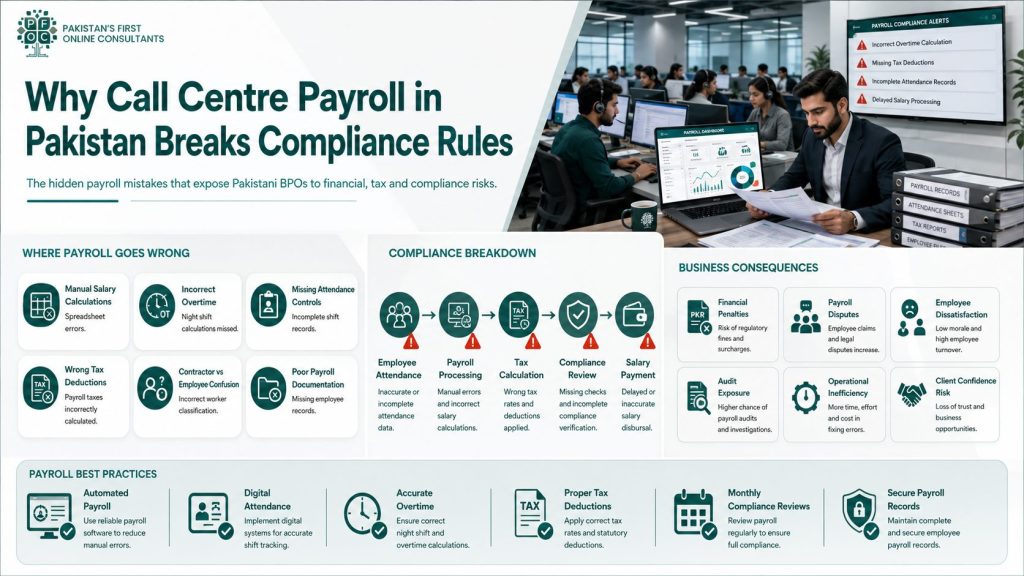
A handful of recurring issues explain most compliance failures:
- Manual processing. Spreadsheets still run payroll at many centres. One wrong formula or duplicated row throws off an entire salary run.
- Incorrect tax calculations. Tax slabs change, and systems don’t always get updated, leading to short or late deposits.
- Improper employee classification. Permanent staff, contract workers, freelancers, and interns each carry different obligations. Mixing them up creates gaps.
- Incentive miscalculations. Commissions and shift allowances shift monthly, and manual tracking rarely keeps pace.
- Attendance and overtime errors. Manual logs and unclear shift differentials lead to inconsistent, disputable pay.
- Poor documentation. Missing contracts, incomplete records, and unissued payslips are the single biggest reason audits go badly.
- Delayed filings. Payroll tax and EOBI submissions carry fixed deadlines, and repeated misses invite scrutiny.
Hidden Mistakes Most Businesses Never Notice
Some payroll problems stay quiet for years: ghost employees, duplicate payments, wrong bank transfers, leave balances that drift out of sync, salary revisions approved verbally but never updated, and bonuses taxed incorrectly because nobody classified them properly.
| Mistake | Consequence | Prevention |
| Ghost employees | Financial loss, fraud risk | Regular headcount reconciliation |
| Duplicate payments | Cash flow leakage | Automated payment matching |
| Wrong bank transfers | Disputes, delays | Verified bank detail updates |
| Incorrect leave balances | Disputes, legal exposure | Integrated attendance-leave systems |
| Unupdated salary revisions | Under/overpayment | Centralized approval workflow |
| Bonus misclassification | Incorrect filings | Clear bonus policy documentation |
The Biggest Compliance Risks
FBR risks include incorrect withholding tax, late payments, and audit notices. EOBI risks include late registration and incorrect contributions. Labour law violations cover weak contracts, below-minimum wages, unclear leave policies, and delayed final settlements. Left unaddressed, these generate employee disputes over pay, overtime, and deductions disputes that create the exact paper trail regulators later use against the business.
The Financial Impact
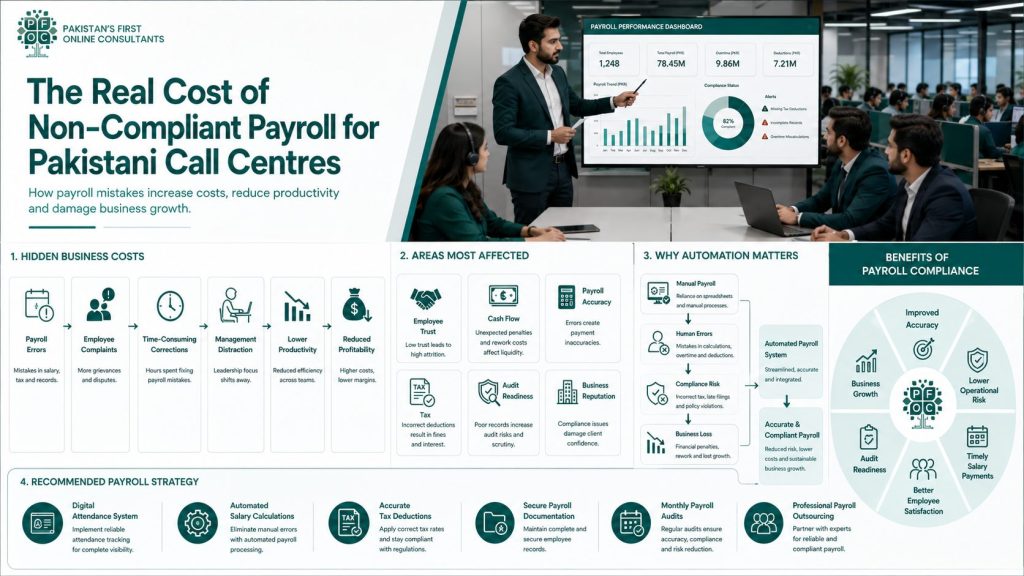
Government penalties are the obvious cost, but rarely the biggest one. Audit preparation eats staff hours. Disengaged employees leave faster in an industry already fighting high attrition. Clients increasingly audit vendors’ compliance standing, so reputational damage spreads beyond the payroll department itself.
Compliance Checklist
Employee documentation: CNIC, signed appointment letter, tax information, salary structure, verified bank details. Payroll records: attendance logs, salary register, payslips, bonus records, reconciled leave records. Government compliance: timely tax deposits, correct EOBI filings, labour law adherence, proper record retention.
Manual vs Automated Payroll
| Manual Payroll | Automated Payroll |
| High error risk | Greater accuracy |
| Time-consuming | Faster processing |
| Difficult audits | Audit-ready records |
| Limited scalability | Easy to scale |
Outsourced vs In-House
In-house payroll gives direct control but demands staff who stay current on tax and labour law expertise that’s expensive to build and easy to lose. Outsourced payroll shifts that burden to specialists, which is why smaller call centres often find it more cost-effective, while growing businesses value the scalability it provides.
Warning Signs of a Broken System
Frequent payroll corrections, employees questioning deductions, late salary processing, missing records, unexpected tax notices, and spreadsheets still doing the heavy lifting. One of these alone might be minor. Several together usually mean the system needs rebuilding.
Common Myths
| Myth | Reality |
| Payroll is just salary processing | It includes tax, EOBI, records, and filings |
| Excel is enough | Spreadsheets can’t scale or audit-proof themselves |
| Small call centres don’t need compliance | Rules apply regardless of size |
| Bonuses are tax-free | Bonuses are taxable income |
| EOBI is optional | Registration is a legal requirement |
Frequently Asked Questions
Why does call centre payroll break compliance rules more often than other industries?
Call centres combine high headcount, constant hiring, shift-based schedules, and incentive-heavy pay four variables that change monthly. Most other industries only deal with one or two of these at once, which is why payroll errors compound faster here.
Is it usually fraud, or just a poor process?
In most cases, it’s process failure, not fraud. Manual spreadsheets, missed tax slab updates, and undocumented approvals cause the majority of compliance breaks. Fraud (like ghost employees) does happen, but it’s less common than simple human error at scale.
Can a call centre be compliant with payroll but still fail an audit?
Yes,this catches a lot of businesses off guard. You can pay every employee correctly and still fail an audit if the documentation behind those payments (contracts, approvals, attendance records) is missing or inconsistent. Auditors check the paper trail as much as the payments themselves.
Do small or mid-sized call centres really need to worry about EOBI and FBR compliance?
Yes. EOBI registration and FBR tax obligations apply based on employee eligibility and salary thresholds, not company size. A 30-seat call centre carries the same legal exposure as a 300-seat one if the basics aren’t handled.
What’s the fastest way to know if payroll compliance is already breaking down?
Watch for frequent post-payment salary corrections, employees repeatedly questioning deductions, and attendance records that don’t match what was actually paid. Any one of these on its own might be minor; two or three together usually signal a system-level problem.
Conclusion
Payroll compliance isn’t a once-a-year task you fix before an audit.it’s an ongoing responsibility that runs from hiring to final settlement. Call centres that treat Call Centre Compliance as a continuous process, not a box to tick, are the ones that avoid penalties and keep employees confident they’re being paid correctly.
PFOC (Pakistan’s First Online Consultants) helps call centres get there reviewing existing payroll, fixing tax and EOBI gaps, and keeping filings on track month after month, so nothing slips through the cracks.
Don’t wait for the first notice from FBR or EOBI. Reach out to PFOC(Pakistan’s First Online Consultants)and get your payroll compliant and audit-ready today.